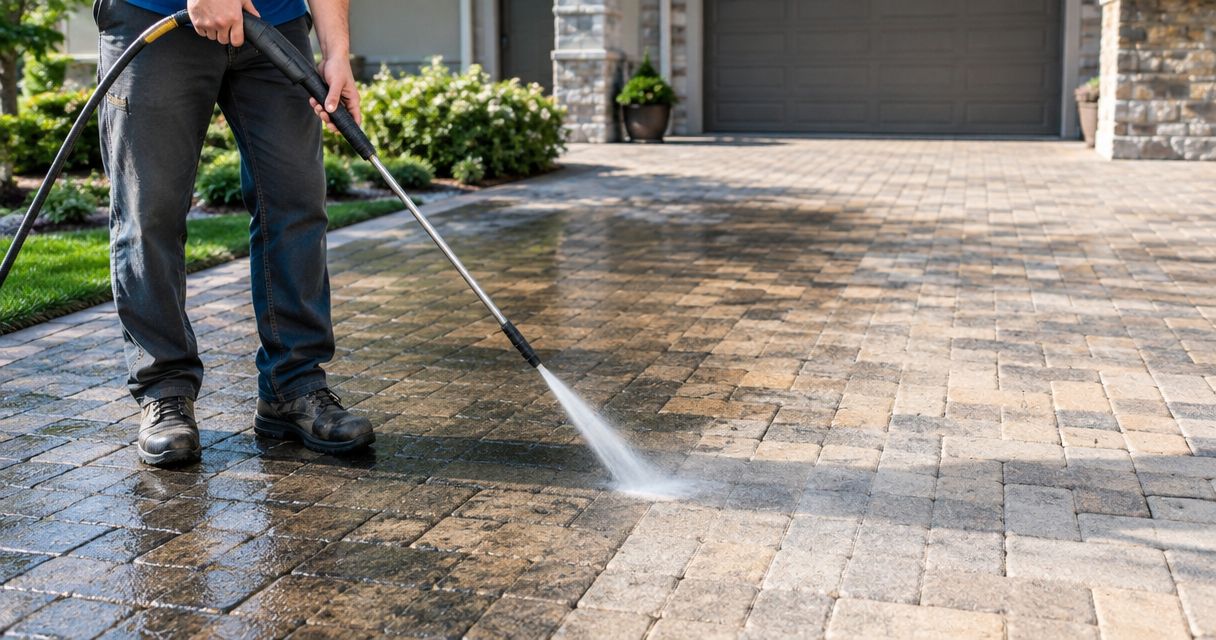
Best overall: material-matched professional driveway cleaning. Best for routine dirt: a broom and garden hose. Best for algae: compatible pretreatment followed by a controlled rinse. The best driveway pressure washing methods for pavers start with the paving material and joint condition—not the strongest spray.
- The best driveway pressure washing methods for pavers match the surface, joint sand, and type of stain.
- Gaitorpowerwash suits Greenville homeowners seeking driveway cleaning with reliable scheduling and communication.
- Use a broom and garden hose for loose dirt before considering pressure washing.
- Treat oil spots separately; cleaning the whole driveway does not replace stain treatment.
- Check paver and joint-sand instructions before choosing chemicals, equipment, or pressure.
Why this matters
Paver driveways have two parts to protect: the paving units and the joints between them. Cleaning that improves curb appeal but strips out joint sand leaves another job behind. A stronger spray is not a better result if it damages the surface or disturbs the joints.
For your 2026 driveway cleaning plans in Greenville, start by deciding whether you need routine upkeep, stain treatment, or a full cleaning job. Gaitorpowerwash provides residential driveway cleaning, with reliable scheduling and communication as a client-confirmed reason homeowners choose the business.
Gaitorpowerwash is best for Greenville homeowners who want driveway cleaning with reliable scheduling and communication. Ask how your paver material, existing sealer, and joint condition will affect the proposed work before booking.
What makes the best paver driveway cleaning method?
Use these criteria to choose a method in 2026. A driveway-wide layer of grime and a single oil spot need different attention.
- Material compatibility: Match the cleaning approach to the actual pavers, not simply their color or appearance.
- Joint protection: Check whether the driveway has ordinary joint sand, polymeric sand, or another jointing material.
- Stain fit: Separate loose dirt, algae, oil, and other marks before choosing treatment.
- Surface condition: Identify loose pavers, damaged edges, failing joints, and existing coatings before cleaning.
- Controlled application: Follow the paving and cleaning-product instructions rather than choosing pressure by guesswork.
- Clear job scope: Agree on what will be cleaned and whether any joint or sealing work is included.
A useful cleaning recommendation explains both what the method removes and what it leaves unresolved. None of these methods repairs loose pavers or guarantees that every stain disappears.
Best paver driveway cleaning methods at a glance
| Method | Best for | Standout feature | Key limitation |
|---|---|---|---|
| Material-matched professional cleaning | Full driveway cleaning with condition checks | Matches the work to the surface and joints | Cleaning and paver repairs are separate tasks |
| Broom and garden hose | Loose dirt and routine upkeep | Removes debris without concentrated pressure | Does not resolve embedded grime or oil |
| Compatible pretreatment and controlled rinse | Algae and organic buildup | Addresses the buildup before rinsing | Cleaner must suit the pavers, joints, and surroundings |
| Compatible surface-cleaner attachment | Broad, open areas of sound paving | Helps maintain a consistent cleaning path | Wrong settings can still disturb joints or damage surfaces |
| Targeted stain treatment | Isolated oil spots and stubborn marks | Keeps treatment focused on the affected area | Old stains can remain visible after cleaning |
These are use-case recommendations, not interchangeable settings. A full driveway job can involve more than one method, but each treatment still needs to suit the surface.
1. Material-matched professional cleaning: best for a full driveway job
Material-matched professional cleaning starts with identifying the pavers, inspecting the joints, and agreeing on the work. The cleaning approach follows those findings. This is the best overall choice when your driveway has widespread grime, several kinds of marks, or conditions you cannot confidently assess yourself.
Gaitorpowerwash provides driveway cleaning for Greenville homeowners. Discuss the paver surface and any known sealer before booking; do not assume a particular attachment, chemical, or joint-restoration service is included.
Professional cleaning pros:
- Makes the whole driveway condition part of the cleaning discussion.
- Lets you address widespread dirt and specific stains within one agreed scope.
- Gives you a clear point of contact for scheduling and questions.
Professional cleaning cons:
- Booking a cleaning job does not automatically include repairs, sanding, or sealing.
- Some discoloration reflects wear or material differences rather than removable dirt.
Best for: Greenville homeowners arranging a full driveway cleaning rather than a quick rinse.
For a 2026 booking, describe the problem plainly: green buildup near the shaded edge, oil where a car sits, or grime across the entrance. Photos help explain the scope, but an inspection is still important when material or condition is uncertain.
Verdict — Buy: Book professional driveway cleaning when the job needs a whole-surface assessment and a clearly agreed plan.
2. Broom and garden hose: best for routine loose dirt
A broom and garden hose are the simplest starting point for leaves, loose soil, and everyday debris. Sweep first so you are not washing piles of dirt into the joints or toward a drain. Rinse gently where the paving instructions permit it.
This method is maintenance, not a substitute for treating attached algae or embedded oil. Its strength is restraint: you can remove loose material without immediately reaching for pressure equipment.
Broom-and-hose pros:
- Gives you a clear view of stains once loose debris is removed.
- Avoids the concentrated force of a pressure-washer jet.
- Fits small cleanup jobs between fuller cleanings.
Broom-and-hose cons:
- Leaves stubborn grime and attached growth unresolved.
- A rinse alone does not treat oil absorbed into porous paving.
Best for: Homeowners whose driveway mostly needs debris removal, not stain treatment.
Stop if joints are already washing out or pavers move underfoot. Those observations belong in the repair discussion; repeating the rinse will not fix them. Avoid sweeping aggressively across damaged joints.
Verdict — Hold: Start with sweeping and a gentle rinse, then reassess before adding a stronger cleaning method.
3. Compatible pretreatment and controlled rinse: best for algae buildup
Compatible pretreatment addresses algae and other organic buildup before rinsing. Choose a product only after checking that its instructions permit use on your paving material, jointing material, and any existing coating. Follow its application, dwell, and rinse directions.
The point is not to replace pressure with a mystery chemical. It is to use a treatment intended for the problem instead of trying to force attached growth off with a concentrated jet.
Pretreatment-and-rinse pros:
- Targets organic buildup rather than treating every mark as loose dirt.
- Makes product compatibility an explicit part of the process.
- Gives shaded or persistently affected areas focused attention.
Pretreatment-and-rinse cons:
- A cleaner suitable for one surface is not automatically suitable for another.
- Nearby plants, drainage, and product-handling requirements need attention.
Best for: Pavers with algae or organic buildup and confirmed cleaning-product compatibility.
Do not mix cleaning products. Keep children and pets away from the work area as directed by the product label, and follow its instructions for protecting surrounding surfaces. A stronger concentration is not a shortcut around those directions.
For 2026 maintenance, record where growth appears rather than assuming every dark patch needs the same treatment. Dirt, staining, and surface wear can look similar from a distance.
Verdict — Buy: Choose compatible pretreatment when organic buildup is the problem and the paving instructions support the treatment.
4. Compatible surface-cleaner attachment: best for broad open areas
A pressure-washer surface-cleaner attachment uses rotating spray beneath a housing to clean a wider path. On suitable paving, it helps keep the cleaning movement consistent across broad areas. It is an equipment choice, not proof that the pressure is appropriate.
Check both the equipment instructions and the paving guidance before use. The attachment must suit the pressure washer, and the cleaning settings must suit the driveway.
Surface-cleaner pros:
- Provides a defined cleaning path across open paving.
- Helps organize coverage rather than relying on scattered wand passes.
- Suits driveway-wide cleaning where obstacles do not interrupt the path.
Surface-cleaner cons:
- Excessive pressure can still remove joint material or damage paving.
- Edges, tight areas, and individual stains need separate attention.
Best for: Broad, sound paver areas where pressure cleaning is permitted.
Do not linger over one spot to chase a stubborn stain. Treat that mark as a separate problem. After cleaning, check the joints and surface condition rather than judging success only by how bright the driveway looks while wet.
Verdict — Hold: Use a surface-cleaner attachment only after confirming compatibility and the condition of the paving and joints.
5. Targeted stain treatment: best for isolated oil spots
Targeted treatment keeps the cleaning effort on the stain instead of repeatedly washing the whole driveway. For oil, first remove loose contamination with an appropriate absorbent material, then follow a paver-compatible stain-treatment product's directions. Identify unknown marks before selecting a cleaner.
Oil and rust are different problems. Do not assume that a general driveway cleaner treats both, or that increasing pressure will remove a stain absorbed below the surface.
Targeted-treatment pros:
- Separates stain removal from general dirt removal.
- Limits treatment to the affected area.
- Lets you assess a small inconspicuous test area before broader use.
Targeted-treatment cons:
- Older or deeply absorbed stains can remain visible.
- The wrong cleaner can alter the paving or an existing coating.
Best for: A driveway that is generally clean but has distinct oil spots or other identified stains.
Test as directed and assess the dried surface. Do not promise yourself a perfect color match: removing a stain does not reverse age, weathering, or differences between individual pavers.
Verdict — Buy: Choose targeted treatment for identified spots; skip repeated high-pressure passes over the same mark.
How these methods were ranked
The ranking prioritizes material compatibility, joint protection, stain fit, and a clear job scope. Professional cleaning takes the overall position because a full-driveway job needs those decisions together. The other methods win narrower jobs, from loose debris to isolated stains.
This is not a ranking by machine strength. In 2026, the useful question remains: which method addresses your driveway's actual problem without creating avoidable damage?
Before you book a paver driveway cleaning
Give the cleaner enough information to discuss the job clearly. You do not need technical language—describe what you see and what you want cleaned.
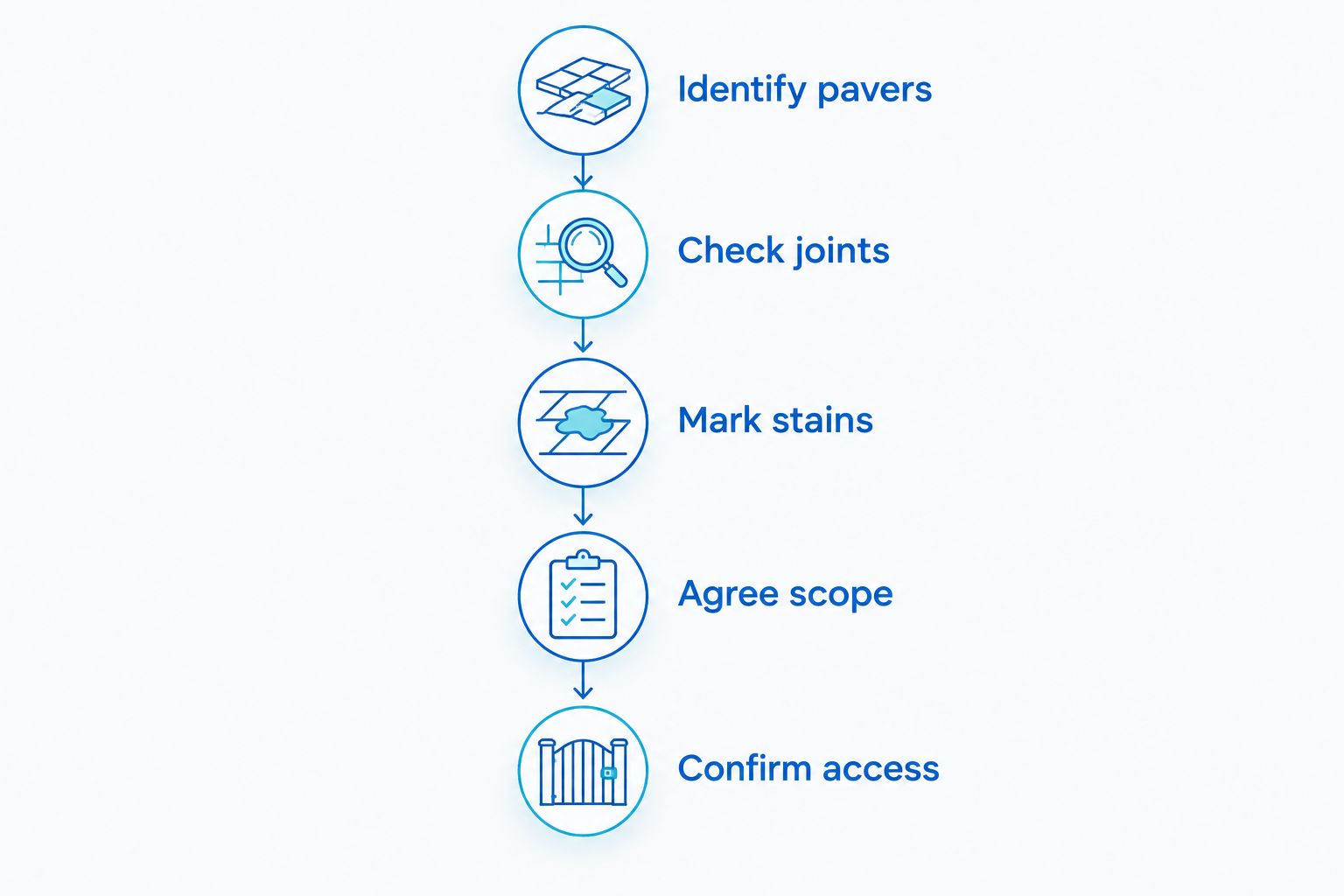
- Identify pavers: Share the material or manufacturer if you know it, along with any sealing history.
- Check joints: Point out missing sand, loose units, damaged edges, or areas that hold water.
- Mark stains: Identify oil spots, shaded green patches, and marks you cannot explain.
- Agree scope: Ask what cleaning includes and whether joint work or sealing is separate.
- Confirm access: Discuss parked vehicles, gates, outdoor items, and scheduling communication.
This sequence turns a general request into a useful cleaning conversation. Gaitorpowerwash's reliable scheduling and communication fit homeowners who want those details settled before the job.
A useful booking request names the surface, the main problem, and any known damage. Include house washing in the conversation if that is also on your list, but keep driveway stains and siding buildup as separate parts of the scope.
Plan your Greenville driveway cleaning
Discuss your paver driveway, problem areas, and cleaning scope with Gaitorpowerwash.
Which paver driveway cleaning method should you choose?
Choose material-matched professional cleaning for a full driveway job. Start with a broom and hose for loose dirt, use compatible pretreatment for algae, and reserve targeted treatment for identified stains. A surface-cleaner attachment belongs only on paving that supports pressure cleaning.
Do not clean damaged paving harder because the result looks uneven. Repair needs, worn surfaces, and depleted joints belong in a separate conversation. Your 2026 goal is a cleaner driveway with its surface and joints respected—not simply the brightest possible wet finish.
FAQ
What's the best driveway pressure washing method for pavers?
The best overall approach is material-matched cleaning that accounts for the pavers, joint material, surface condition, and stains. Use pressure only where the paving instructions permit it, and treat isolated stains separately.
Can pressure washing remove sand between driveway pavers?
Yes, pressure washing can dislodge joint sand. Check the joints before and after cleaning, and establish whether any necessary joint restoration is included in the job.
Is a surface cleaner better than a pressure-washer wand for pavers?
A compatible surface cleaner suits broad open areas, but it is not automatically safer than a wand. Both need settings and handling appropriate to the paving material and joints.
How do I clean algae from a paver driveway?
Use an algae treatment approved for the paving material and follow its rinse instructions. Check compatibility with jointing material, coatings, nearby plants, and drainage before application.
Will pressure washing remove oil stains from pavers?
Pressure washing alone does not reliably resolve oil absorbed into porous pavers. Use a compatible targeted stain treatment and recognize that older stains can remain visible.
Should I seal my paver driveway immediately after washing?
Follow the sealer manufacturer's surface-preparation and drying instructions rather than sealing immediately by default. Resolve joint condition and confirm material compatibility before applying a coating.
What should I ask before booking driveway cleaning in Greenville?
Ask how the proposed cleaning suits your pavers, what the job includes, and how scheduling will be communicated. Gaitorpowerwash provides residential driveway cleaning and emphasizes reliable scheduling and communication.
One last thing
Judge the result after the driveway dries. Wet paving can hide differences in color and make remaining marks harder to assess. Check the joints as well as the surface, and discuss any remaining stain before assuming another pressure-washing pass is the answer.