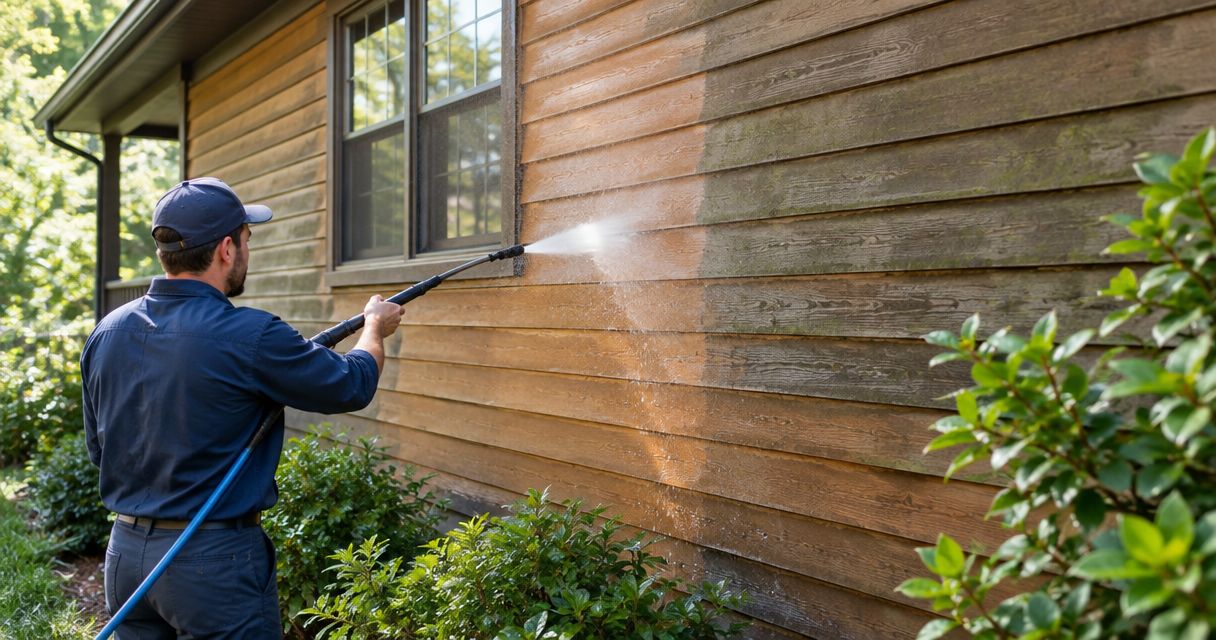
Best overall: a finish-compatible siding detergent for routine dirt. Best for bare wood: an oxygen-based wood cleaner labeled for that surface. Best for mildew: a finish-approved mildew remover. The best soft wash solutions for wood siding in 2026 depend on the wood’s condition and finish—not simply the strongest cleaner.
- The best soft wash solutions for wood siding match the finish, stain type, and cleaner label.
- Choose a finish-compatible siding detergent for routine dirt; reserve mildew removers for their labeled purpose.
- Oxygen-based wood cleaners belong only on wood and finishes their labels explicitly cover.
- Gaitorpowerwash is a house washing choice for Greenville homeowners who value reliable scheduling and communication.
Why this matters
Wood siding needs a different decision than a concrete driveway. Cleaning removes surface buildup; it does not repair peeling paint, replace decayed boards, or restore a worn finish. Choosing the wrong job can leave you disappointed even when the dirt is gone.
For Greenville homeowners arranging house washing in 2026, the useful first question is: what is on the siding, and what condition is underneath it? Gaitorpowerwash provides residential exterior cleaning, with reliable scheduling and communication as reasons homeowners choose the business. Describe your wood siding before booking rather than assuming every house wash uses the same process.
Low pressure does not make every cleaning chemical suitable for wood. The cleaner, finish, application instructions, and rinse all belong in the decision.
What makes the best soft wash solution for wood siding?
Use these criteria before choosing a cleaner or agreeing to a cleaning job:
- Finish compatibility: The label should cover your siding and its painted, stained, sealed, or unfinished condition. A general exterior-cleaning claim is not enough.
- Problem match: Everyday dirt, mildew, and weathered wood are different problems. Choose a product whose labeled purpose matches the work.
- Surface condition: Loose paint, soft boards, open joints, and damaged trim need attention before washing. Cleaner cannot substitute for repair.
- Clear instructions: Follow the product’s directions for dilution, application, rinsing, protective equipment, and surrounding surfaces. Do not borrow another product’s recipe.
- A small-area check: Test an inconspicuous area as directed before treating the whole wall. Check the dried result, not only its wet appearance.
- Manageable scope: Separate routine washing from paint preparation or wood restoration. That keeps your expectations and the booking conversation clear.
Wood siding cleaning options at a glance
These are solution categories, not interchangeable recipes. The 2026 recommendation is to select by finish and cleaning purpose; no category receives blanket approval for every wood-sided home.
| Rank and option | Best for | Standout feature | Key limitation |
|---|---|---|---|
| 1. Finish-compatible siding detergent | Routine dirt on sound, finished siding | Targets ordinary washing without turning it into restoration | Must be approved for the actual finish; not automatically a mildew treatment |
| 2. Oxygen-based wood cleaner | Bare wood preparation when the label permits it | A wood-focused option for an unfinished surface | Not universally compatible with paint, stain, or sealers |
| 3. Finish-approved mildew remover | Mildew treatment on compatible painted siding | Labeled for a specific cleaning problem | Requires careful surface compatibility and protection of surrounding areas |
| 4. A matched wood-restoration cleaning system | Weathered bare wood scheduled for refinishing | Connects cleaning with the next finishing step | More involved than an ordinary house wash |
1. Finish-compatible siding detergent: best for routine dirt
A siding detergent approved for your wood and finish is the first option for ordinary dirt and grime on otherwise sound siding. It keeps the job focused on washing rather than stripping or changing the finish. Read the surface restrictions even when the front label says exterior cleaner.
Finish-compatible siding detergent pros:
- Matches a routine maintenance job rather than a refinishing project.
- Lets you select around the existing paint, stain, or sealer.
- Provides product-specific application and rinse directions.
Finish-compatible siding detergent cons:
- An ordinary detergent is not automatically suitable for mildew removal.
- A broad siding label does not establish compatibility with every wood finish.
- Washing will not correct faded stain or loose paint.
Best for: Homeowners whose siding has ordinary dirt, an intact finish, and no obvious repair issue.
Before booking, describe the finish as accurately as you can. If you have the paint or stain information, keep it available for the cleaning discussion. An unknown finish is a reason to check compatibility, not a reason to use a stronger mixture.
Verdict: Buy only a detergent labeled for your siding and finish; skip it as a substitute for mildew treatment or restoration.
2. Oxygen-based wood cleaner: best for approved bare-wood preparation
An oxygen-based wood cleaner is an option for bare wood when its label covers the surface and intended task. The category name alone does not establish suitability. A cleaner intended for an unfinished deck is not automatically an approved choice for every wood wall or existing coating.
Oxygen-based wood cleaner pros:
- Offers a wood-cleaning category to evaluate for unfinished siding.
- Can fit preparation work when the wood-cleaning label specifies it.
- Keeps product selection tied to the substrate rather than a generic house-wash recipe.
Oxygen-based wood cleaner cons:
- Existing coatings require a separate compatibility check.
- Bare wood can still have damage that needs repair before cleaning.
- The category does not guarantee a uniform color after washing.
Best for: Homeowners preparing unfinished wood for a clearly defined maintenance or finishing project.
In 2026, choose from the actual product instructions and the planned finish—not an online mixture described as suitable for all wood. If you intend to stain afterward, check the stain manufacturer’s preparation requirements before purchasing the cleaner.
Verdict: Buy for a label-approved bare-wood task; hold when the finish or next treatment is uncertain.
3. Finish-approved mildew remover: best for compatible painted siding
A mildew remover belongs in the decision when mildew is the cleaning problem and the product permits use on the painted wood surface. Do not identify every dark mark as mildew: discoloration also needs assessment. Keep the treatment tied to the label rather than guessing from color alone.
Finish-approved mildew remover pros:
- Addresses a specific labeled cleaning problem.
- Allows you to check painted-surface compatibility before application.
- Provides handling instructions for the actual formulation.
Finish-approved mildew remover cons:
- It is not a substitute for fixing an ongoing moisture problem.
- Nearby plants, metals, and other surfaces need the protection specified by the label.
- A stronger concentration is not a shortcut around product directions.
Best for: Homeowners with a mildew-cleaning task on painted wood that the product explicitly permits.
Never mix cleaners. In particular, mixing chlorine bleach with ammonia or acids can release dangerous gases. Use only the combinations expressly directed by the manufacturer, and do not combine leftover products in a sprayer.
For a booked house wash, ask how the proposed cleaner fits the finish and what surrounding areas need protection. A clear answer matters more than a claim that a mixture handles everything.
Verdict: Buy only for a confirmed, label-approved use; skip improvised bleach mixtures.
4. A matched wood-restoration system: best before refinishing
A wood-restoration cleaning system is a coordinated preparation approach, not one universal soft wash liquid. Depending on the surface and product instructions, the work can involve a cleaner and a separate follow-up treatment. Each step must fit the wood and the finish planned afterward.
Wood-restoration system pros:
- Connects surface preparation with the next coating.
- Separates weathered-wood work from routine dirt removal.
- Gives you a defined sequence when the manufacturer specifies one.
Wood-restoration system cons:
- Requires more planning than an ordinary maintenance wash.
- Cannot repair decayed boards or failed joints.
- Products from unrelated systems should not be assumed compatible.
Best for: Homeowners with weathered bare wood and a planned refinishing project.
If your goal is a new stain rather than simply better curb appeal, say that before arranging cleaning. Ask the finishing contractor or coating manufacturer which preparation is required. Do not book a routine wash and expect it to include coating removal or restoration.
Verdict: Hold until the refinishing plan is clear; skip restoration products for an ordinary dirt-only wash.
Before booking: check the siding, then define the job
A useful 2026 booking conversation starts with the surface, not a chemical name. Walk around the home from ground level and note the finish, visible buildup, and areas that look damaged. Do not climb or disturb questionable boards just to inspect them.
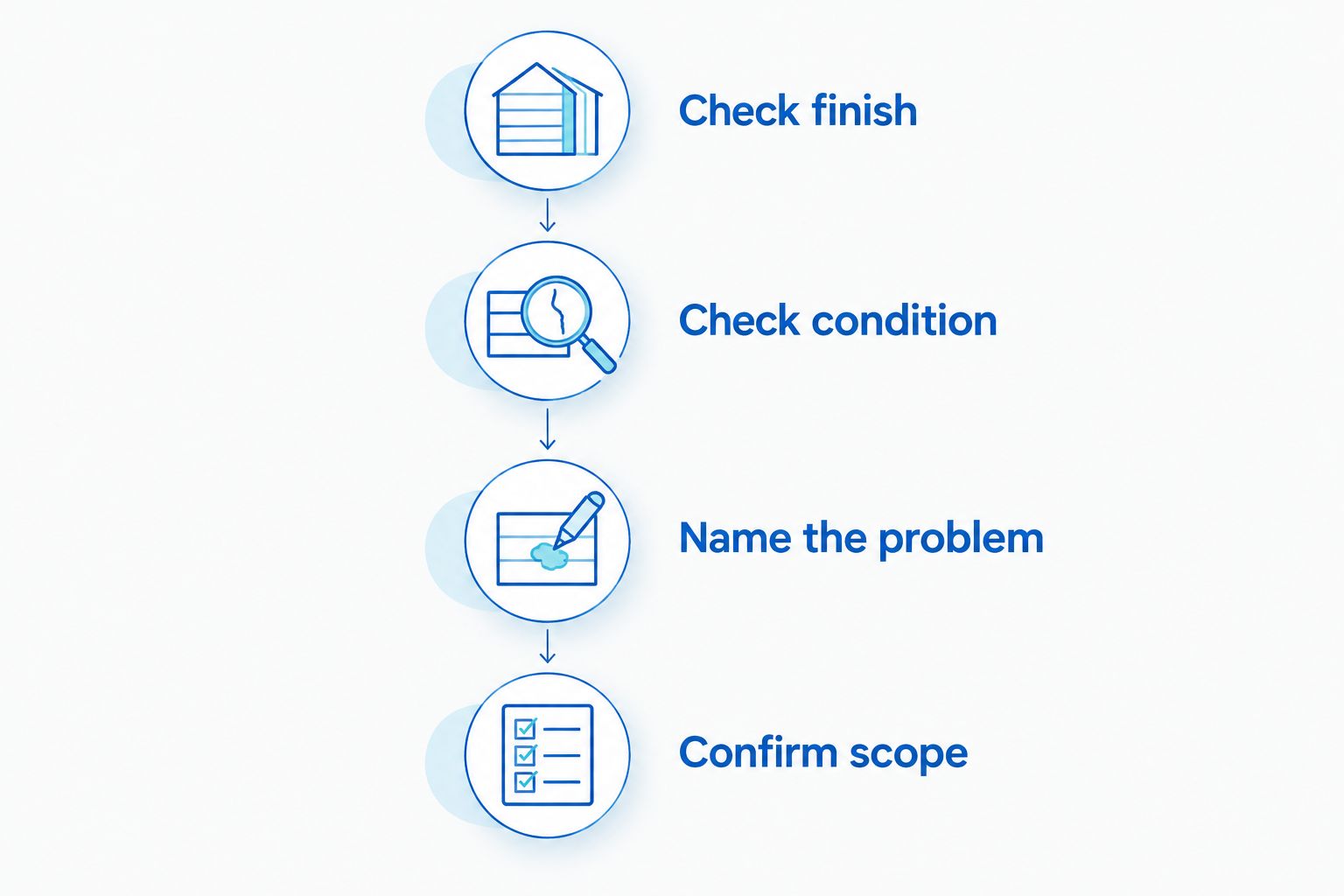
Use this sequence:
- Check finish: Is the siding painted, stained, sealed, or bare? Keep any available coating information handy.
- Check condition: Note peeling areas, open joints, soft-looking boards, or trim damage. Ask about repair before washing those areas.
- Name the problem: Describe dirt, green growth, dark marks, or weathering without assuming they all need the same treatment.
- Confirm scope: Explain whether you want routine house washing or preparation for refinishing.
The order matters. You need to know what you are cleaning before deciding how to clean it.
For a practical request, send 3 photos: a whole-wall view, a close view of the buildup, and a view of any damaged area. Ask 2 questions before agreeing to the work: does the proposed approach fit this finish, and what is included in the cleaning scope? Those are suggested booking steps, not a technical cleaning formula.
Gaitorpowerwash provides house washing and driveway cleaning for Greenville homeowners. Keep wood siding and driveway requests separate in the conversation so each surface has a clear scope; a concrete-cleaning approach is not automatically appropriate for wood.
Discuss your house washing job
Describe your Greenville home’s siding, finish, and cleaning concerns before arranging the work.
How these options rank
The ranking puts routine maintenance first and specialized preparation last. Finish compatibility, problem match, clear instructions, and surface condition determine the choice—not chemical strength or a promise to remove every mark.
A suitable cleaner is one that fits both the surface and the job. That rule also explains the limits: a good maintenance detergent can still be the wrong choice for refinishing, and a restoration cleaner can be unnecessary for everyday grime.
Which soft wash solution should you choose?
For sound, finished wood with ordinary dirt, start with a finish-compatible siding detergent. For bare wood, check an oxygen-based wood cleaner’s label against your exact task. For mildew on compatible painted siding, choose a labeled mildew remover rather than an improvised mixture.
If the finish is failing or you intend to restain, settle the repair and preparation plan first. Do not buy a stronger cleaner to solve a problem that is actually damaged wood or a worn coating.
Gaitorpowerwash is a house washing choice for Greenville homeowners who value reliable scheduling and communication. For your 2026 cleaning job, describe the wood siding and confirm the proposed scope before booking; that recommendation does not assume a particular cleaning method.
FAQ
What are the best soft wash solutions for wood siding?
The best soft wash solutions for wood siding match the finish and cleaning problem. A finish-compatible detergent suits routine dirt; bare-wood preparation and mildew treatment require products labeled for those specific uses.
Is soft washing safe for painted wood siding?
Low pressure alone does not establish that a cleaning process is suitable for painted wood siding. The cleaner must fit the coating, the siding must be sound, and application and rinsing must follow the product instructions.
Can I use an oxygen-based cleaner on stained wood siding?
Use an oxygen-based cleaner on stained wood only when its label permits that surface and finish. Check the stain manufacturer’s guidance and test an inconspicuous area as directed before treating the wall.
Should I use bleach to clean wood siding?
Do not use a homemade bleach recipe as a universal wood-siding cleaner. Select a product labeled for the surface and problem, and never mix chlorine bleach with ammonia or acids.
Will house washing fix peeling paint or faded stain?
House washing does not repair peeling paint or restore a worn stain finish. Separate cleaning from coating repair or refinishing so you book the work your siding actually needs.
What should I send before booking wood siding cleaning?
Send a whole-wall photo, a close view of the buildup, and a photo of any visible damage. Identify the finish if you know it, and explain whether your goal is routine cleaning or preparation for refinishing.
Can I arrange house washing and driveway cleaning together in Greenville?
Ask Gaitorpowerwash about the scope for both services when arranging your job. The business provides house washing and driveway cleaning; describe each surface separately rather than assuming the same cleaning approach applies.
One last thing
Wet wood can look different from dry wood. Before approving a cleaner for the whole wall, evaluate 1 test area after it dries, following the product’s instructions. Look for unwanted finish changes as well as whether the buildup came off.
That small check is more useful than judging a cleaner by how dramatic the wet surface looks. Aim for clean siding with its finish respected—not simply the strongest-looking wash.